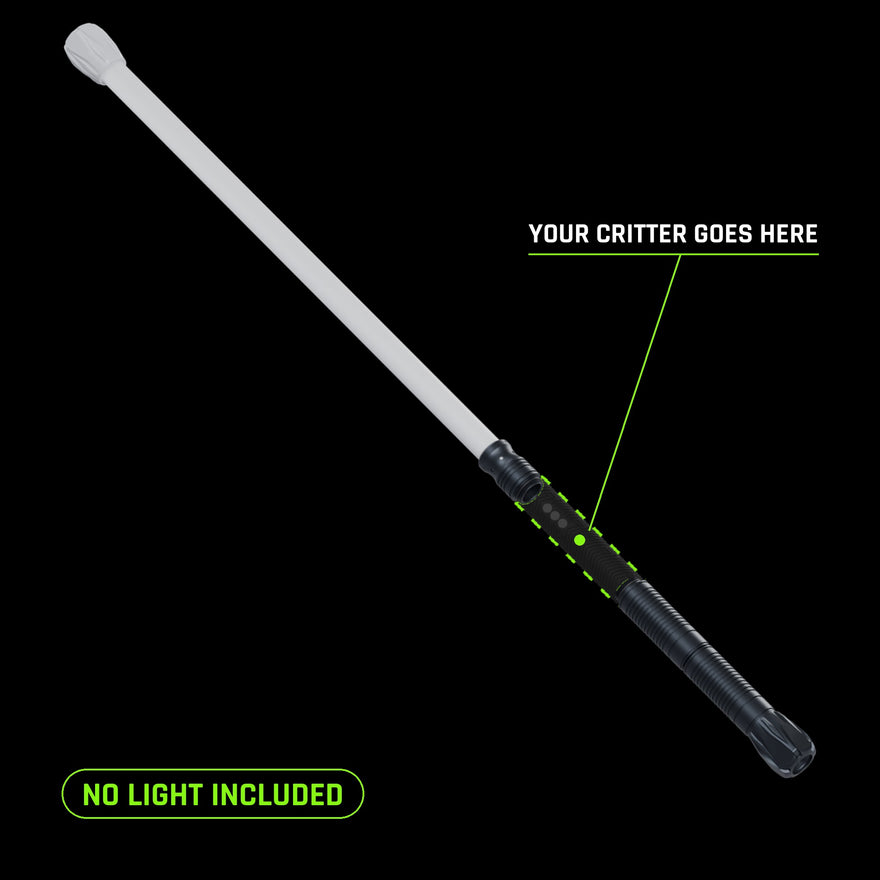
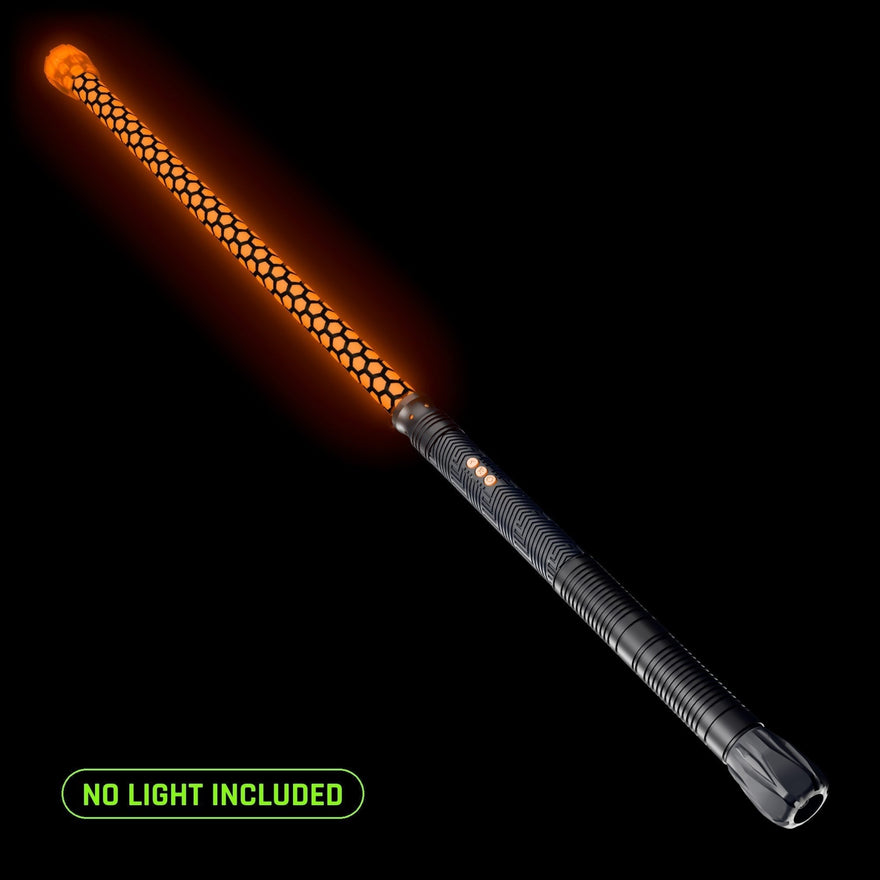
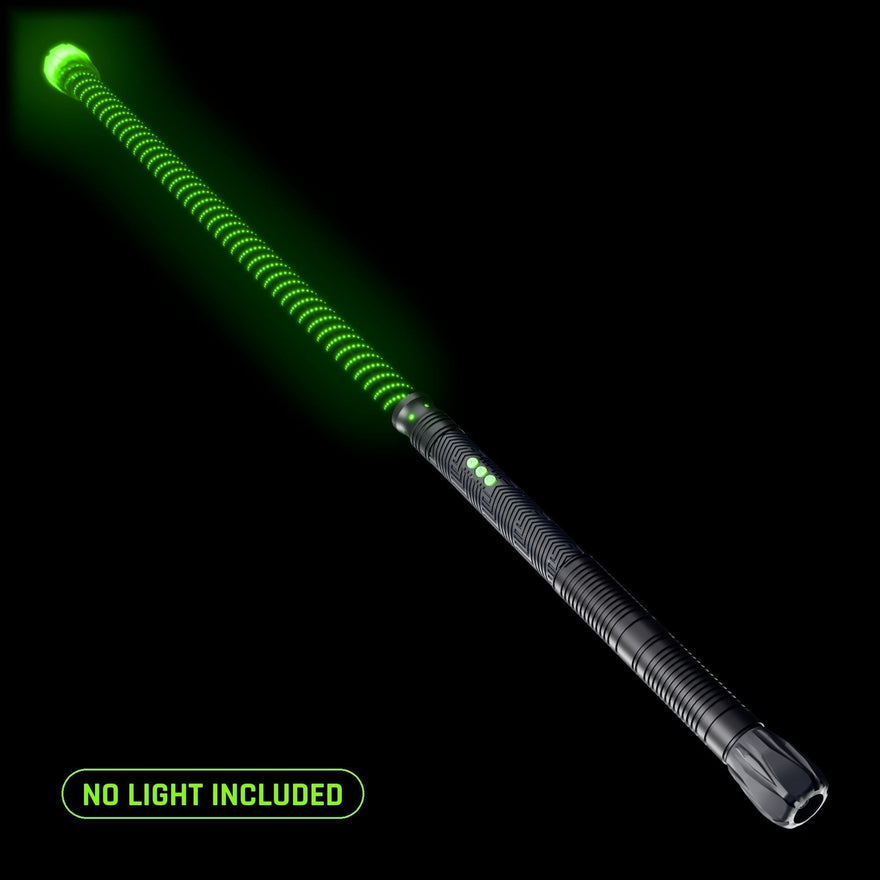
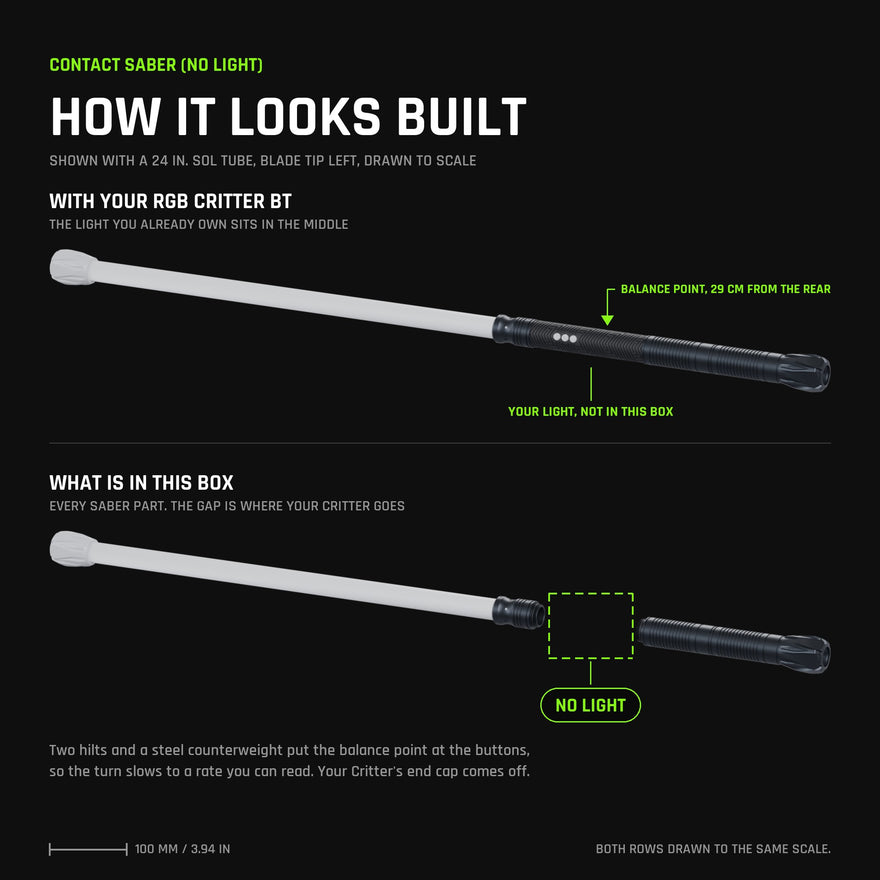
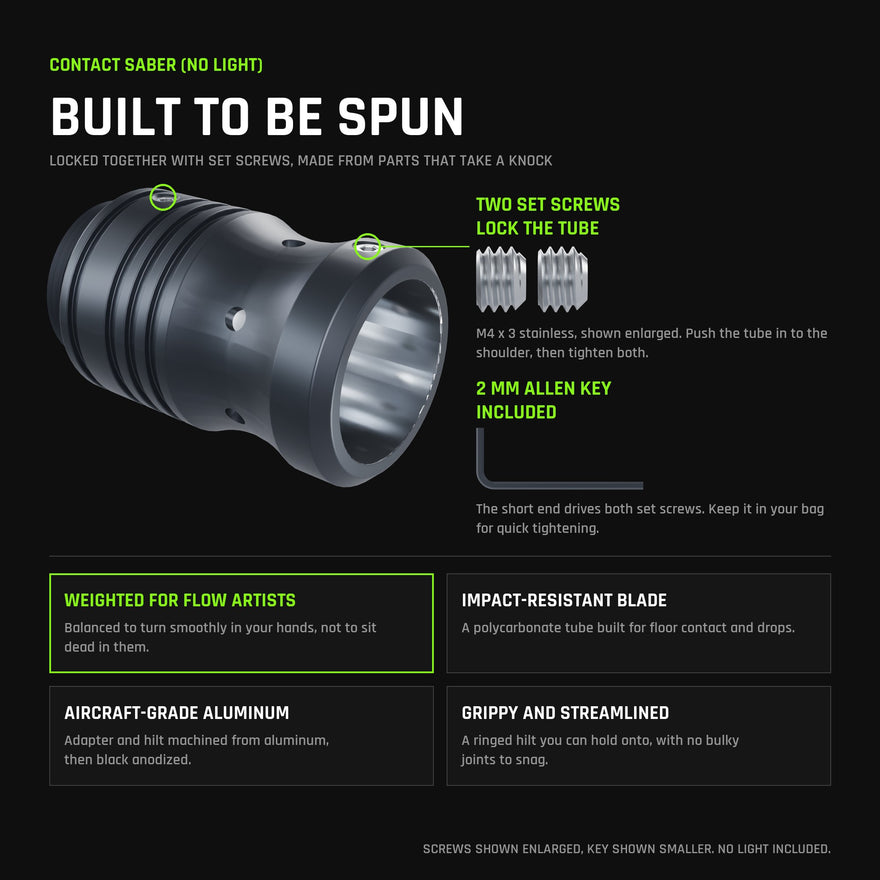
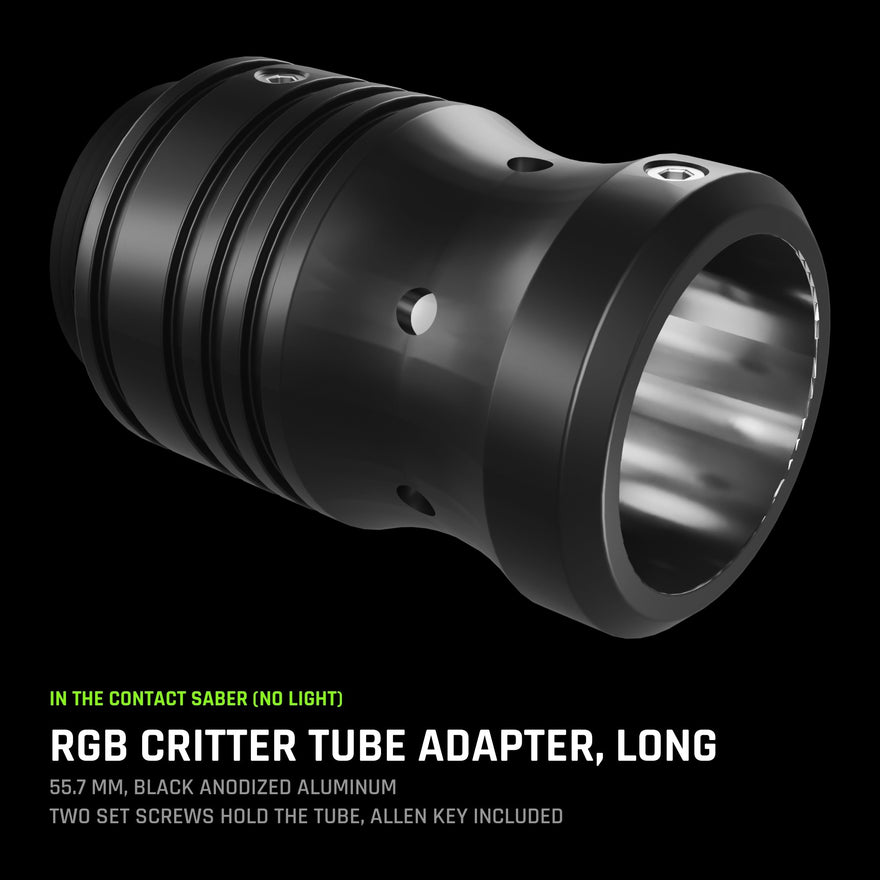
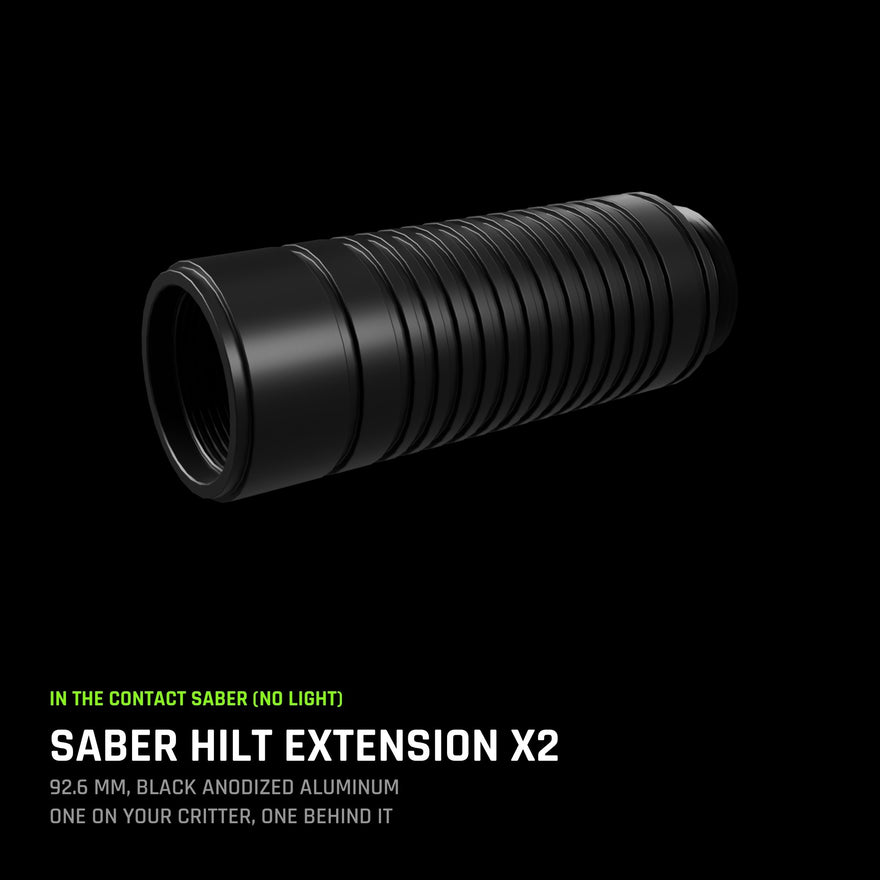
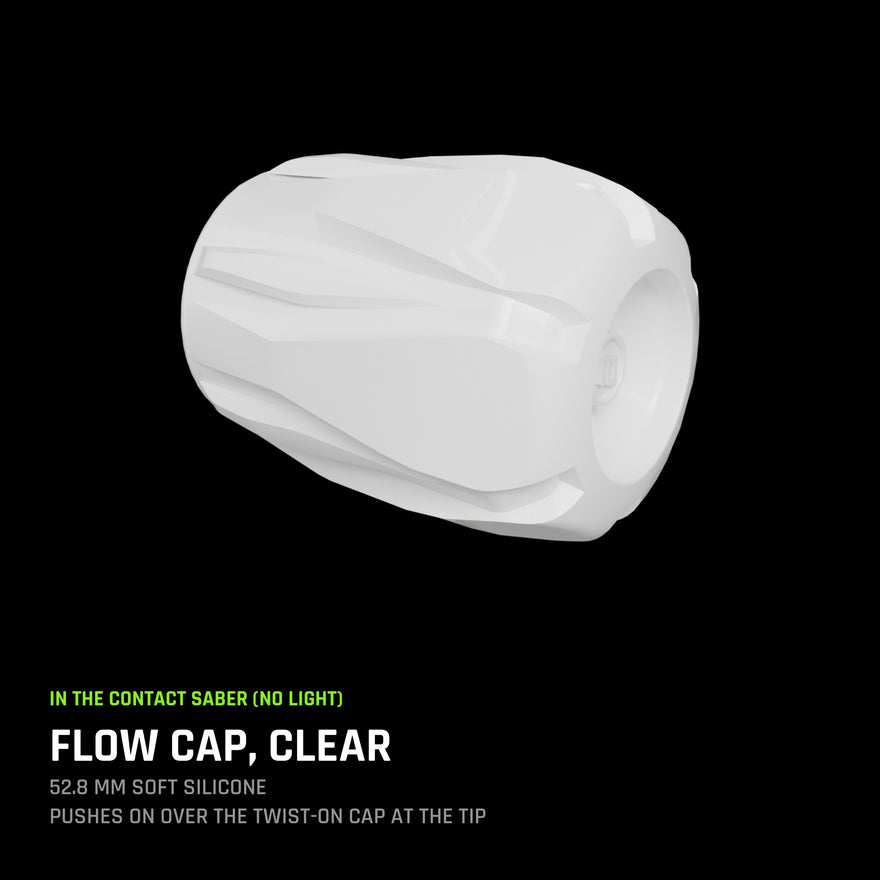
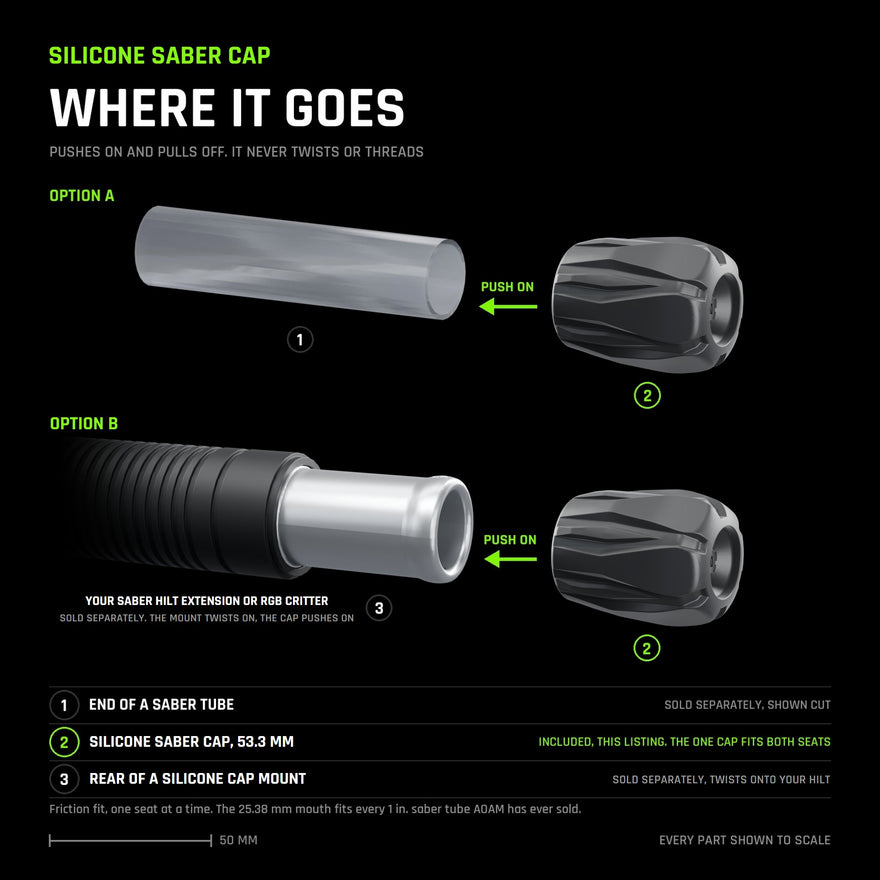
No light engine in this box. It runs on the RGB Critter BT you already own, sold separately.
Your Critter's own end cap comes off; the black Silicone Saber Cap closes the back.
It costs less than buying the parts separately, and the price box shows your exact saving for the pattern you pick.
Which length? How length and weight change the feelShow less
A longer contact saber turns slower. A shorter one turns faster. Long gives you big, smooth rolls with time to think inside each one. Short gives you quick, snappy spins and tight moves close to the body. Neither is better: they suit different moves and different tempos, so pick the one that fits how you want to spin.
What "contact" means
In flow arts, contact means the prop moves while touching your body instead of being held in your hand. The saber rolls across your forearms, shoulders, neck, back or legs, and you guide it with your body rather than gripping it. Chain several rolls and wraps together without grabbing the saber and you have a contact combo.
Why a longer saber turns slower
Every prop resists being spun up or slowed down, and each bit of mass counts by the square of its distance from the turning point: mass twice as far out resists four times as much. A longer blade adds mass and puts it farther out, so the same push spins it up more slowly, and once it is turning it holds that turn longer. In rolls where gravity and your body do most of the work, a longer saber settles into a somewhat slower pace, a bit like a longer pendulum swinging a little slower.
Slower turning does not mean a slower tip. The tip of a long saber sits much farther out, so it still moves faster and draws a bigger light trail.
-
30 or 36 inch: slower turns, bigger arcs, more time in each roll, and the reach for moves that travel across your back, shoulders and torso. Calm and forgiving. Needs more room around you and over your head.
-
18 or 24 inch: faster turns, tighter arcs, quicker direction changes. Lively, rewards precise timing, and easier in a small room.
- Many people learning contact find the slower pace of a longer saber easier to follow. If you already spin fast and want snap, go shorter.
What the end weights do
Mass at both ends raises the saber's resistance to turning without making it longer. The turn slows to a pace you can read, bumps and uneven pushes change its spin less (the way a flywheel keeps an engine running evenly), and it carries more spin at any speed, so it rolls through the drag of skin and clothing and holds its plane more firmly. You guide it more and drive it less. The honest trade-off: it takes more effort to start, stop, reverse and tip into a new plane.
Where centrifugal force comes in
As the saber spins, each end wants to keep travelling in a straight line, and you feel the pull of keeping it on its circle as centrifugal force. It grows with the end's mass, its distance from the turning point, and the square of how fast it turns. Spinning around its balance point, the pulls from the two ends cancel, which is why this saber feels calm at the buttons. When it turns around a point away from the balance point, like your neck or elbow in a wrap, you feel that outward pull, and it helps you sense where the saber is without looking.
What the silicone caps do
The caps give the tips a little bite, so when an end touches your hand or body it is less likely to skate away. Drops and bumps at the ends meet soft silicone instead of hard plastic, and because the caps sit at the very ends, their mass does the most for steadiness.