Fiber Optic Brushes and Wands: What They Are and How to Light Paint With One
 9 min read
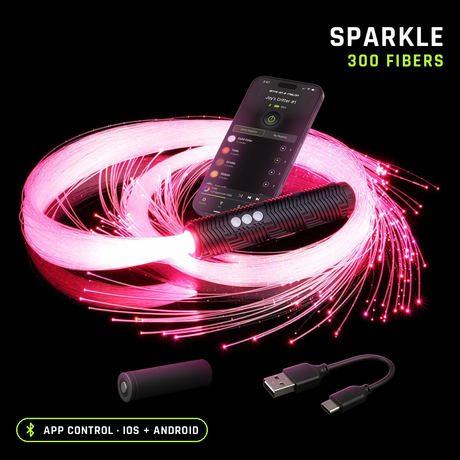
A fiber optic brush, also called a fiber optic wand, is a short bundle of fiber optic strands sitting on a light, so every strand carries color to its tip and the whole thing glows like a brush made of stars. Light painters use them to paint soft, feathered trails in long exposures, and flow artists know the long version as a whip. We make fiber tools for the RGB Critter BT in Oregon, so this guide covers what a wand is, how it differs from a whip, and how to get good photos out of one on the first night.
What is a fiber optic brush? A brush made of light
Every fiber optic strand is a thin thread of plastic that traps light inside it and carries it to the end. Bundle a few hundred strands together, put a bright light at the base, and you get a wand: a handheld tool where each strand is its own point of light.
You will also see it called a fiber duster, a light brush or a fiber wand. They all mean a short bundle of fibers on a light. Ours is the Fiber Optic Duster, a 10-inch bundle of end glow fiber that twists straight onto any RGB Critter Light Engine with no adapter.

The one thing a wand is not is the spinning party wand sold in toy aisles. Those are built to be waved at a concert, not steered through a long exposure, and they have no control over color or brightness.
Fiber optic wand vs fiber optic whip: same fiber, different job
A wand and a whip are made of exactly the same material. The difference is length and what you do with it.
- A wand is short (our Duster is 10 inches) and stiff enough to steer. You hold it like a paintbrush and place light exactly where you want it in the frame.
- A whip is long (the BitWhip is 5.5 feet, or 7 feet in Extra Long) and loose. You spin it, and it pulls a ribbon of light behind it for flow arts and performance.
Because both twist onto the same RGB Critter BT, you do not have to choose. The light that runs your whip at a festival runs your wand on a photo shoot the next night, and swapping takes a few seconds.
When "light wand" means a tube: the other kind of wand
In light painting, "light wand" or "LED wand" usually means something else: a translucent tube lit from one end, which paints a solid bar of light instead of fine strands. Sweep it through the frame and you get smooth, bold ribbons of color.
Ours is the Light Painting Tube, an impact-resistant polycarbonate tube in lengths from 5 to 36 inches ($24.95 to $54.95). It mounts on the same RGB Critter BT with an RGB Critter Tube Adapter (from $29.95), so one light runs your fiber brush, your tube and your whip.
Tubes reward steady movement. Walk sideways in a slow, even pattern and avoid going back over an area you have already painted, or it overexposes. Try a strobing mode on a tube too: the flashes turn a smooth bar into stripes.

Brush or tube? A fiber brush paints soft, textured, feathery light. A tube paints clean, solid strokes. Most light painters end up using both.
How to light paint with a fiber optic wand: four moves to start with
Put your camera on a tripod and start from our base recipe: ISO 200, f/8, a 10 to 25 second shutter, manual focus and Daylight white balance. Then try these, one per frame, so you can see what each one does.
- The sweep. Walk the wand slowly across the frame with the tips pointing at the camera. The strands blend into a soft, textured band of color, the look most people picture when they think of a fiber brush.
- The side-on pass. Turn the wand so the strands face across the frame instead of at the lens. You get fine individual lines, almost like hair, instead of a solid band.
- The stamp. Hold the wand still for a second, then cover it or switch it off and move. Each pause prints a small starburst, and a row of them reads as a pattern.
- The twist. Rotate the wand in place as you move. The spread of the strands turns into a spiral, which is the quickest way to get something that looks planned on your first try.
Speed is a dial, not a rule. Move slowly and the trail comes out bright and dense; move quickly and the light spreads thin and even, which is what you want when you are washing color over a person or a wall. Our camera settings cheat sheet covers what to change if trails come out too bright or too dim.
Painting a person with a fiber brush: portraits and auras
Fiber brushes are at their best on people, because the strands wrap light around a face and shoulders in a way a solid tool cannot. Two approaches cover most of what you will see.
- The body scan. With your subject standing still, sweep the brush over them from head to toe in one smooth pass of a few seconds, holding it roughly 1 to 2 feet (30 to 60 cm) away. Keep it moving, keep it away from their eyes, and try not to pass over the same spot twice, or that spot blows out.
- The aura. Stand behind your subject and flick just the tips of the fibers around their outline, working from the head down. The body stays dark and a glowing edge draws the shape. A second color on a second pass, after they step aside, gives you two figures in one frame.
People cannot hold perfectly still for long, so keep the painting itself to a few seconds. If you want a sharp face, light it for a moment at the start of the exposure with a quick flash or a brief burst from a flashlight, then paint. Have your subject wear dark clothes, and put a small mark on the ground so they can find their spot again between frames.

Color and brightness: the light does the work
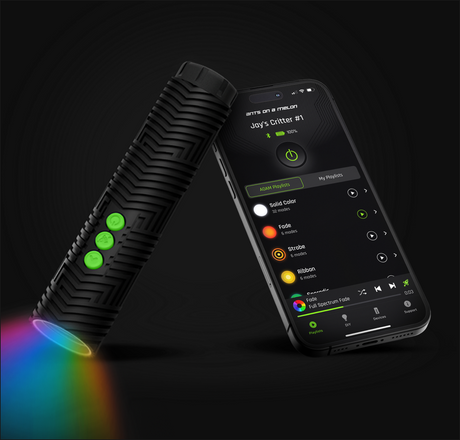
The fibers carry whatever the light puts into them. On the RGB Critter BT that means 16+ million colors and 100 brightness levels, set from the app or the three onboard buttons.
One thing that catches people out: colored light is dimmer than white. If your settings are right for white and you switch to deep blue or red, the trail can drop by a stop or more. Open the aperture a little (f/5.6 instead of f/8) or raise the ISO to 400 when you paint in saturated color.
For a first shoot, pick one solid color and drop the brightness to around a third. A wand held close to the camera is brighter than people expect, and a lower setting keeps the strand detail instead of burning it into a blob. Save the color-changing modes for later: a mode that strobes prints as a dashed line, which is a great effect once you want it and a confusing one when you do not.
Black Duster, @zo_after_dark
White Duster, @lightnlense
The mistakes everyone makes once: and the fixes
- A ghost of you in the frame. Standing still while the light is on records you. Keep moving, wear black, and switch the light off before you stop.
- Walking between the light and the lens. Your body blocks the trail and leaves a gap. Work beside or behind the brush, not in front of it.
- A hard hotspot. The bright body of the light shows up as a blinding dot if it faces the camera. Keep the RGB Critter BT pointed away from the lens and let only the fibers face it.
- Waiting twice as long for every shot. Long exposure noise reduction doubles the time each frame takes. Turn it off and shoot RAW.
End glow fiber on a wand: why the tips matter
End glow fiber sends almost all of its light out through the tip of each strand, so a wand pointed at the camera shows a crisp field of bright points. That is why the Duster uses it. Sparkle fiber, which leaks light along the whole strand, is covered in our End Glow vs Sparkle guide and is mostly a whip choice.
The Duster comes in five colors of fiber coating: Black, White, Blue, Green and Pink. Keep the black one dry, because its coating can bleed if it gets wet.

What you need to start: two parts
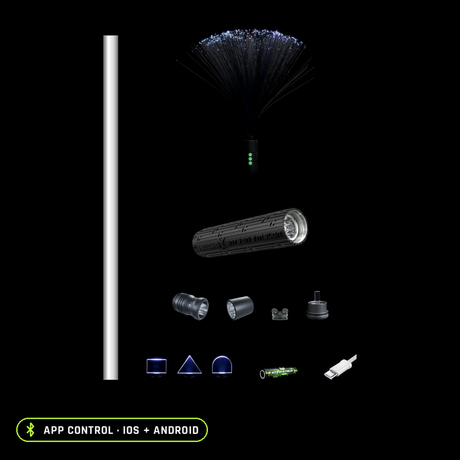
- Fiber Optic Duster, $19.95. Twists straight onto the light.
- RGB Critter BT Light Engine, $149.95. The light source, with a replaceable 18650 battery, USB-C charging and up to 7 hours of runtime (about 2 hours on full white).
If you already own a BitWhip, you already own the light. The Duster is the cheapest way to turn your whip into a light painting kit.
Brush, tube or whip?
Soft, textured light around a person
A fiber brush
The Fiber Optic Duster, $19.95 on an RGB Critter BT.
Clean, solid strokes and big shapes
A tube
The Light Painting Tube, 5 to 36 inches, plus the tube adapter.
Not sure yet
Start with the light
The RGB Critter BT runs the brush, the tube and the whip, so you can add tools one at a time.
Fiber optic brush and wand FAQ
What is a fiber optic brush or wand used for?
Mostly light painting photography, where it acts as a brush that paints soft, textured trails in a long exposure. Flow artists use the long version, the fiber optic whip, for performance.
Is a fiber optic duster the same as a fiber optic wand?
Yes. Duster, brush, light brush and wand all describe a short bundle of fiber optic strands on a light.
Is a light wand the same as a fiber optic wand?
Not usually. In light painting, a "light wand" or "LED wand" normally means a lit tube that paints solid strokes, while a fiber optic wand or brush paints fine, textured strands.
Can I use a fiber optic wand without a camera?
You can, and it looks lovely in a dark room, but the long exposure is what turns the motion into a picture.
Do I need an app?
No. The RGB Critter BT runs from its three onboard buttons. The app is there when you want an exact color or your own modes.
Can the same light run a wand and a whip?
Yes. The Duster and the BitWhip both twist onto the RGB Critter BT, along with 200+ other accessories.
How far away should I hold a fiber brush when painting a person?
About 1 to 2 feet (30 to 60 cm), moving steadily and keeping it away from their eyes. Closer and slower makes it brighter; farther and faster makes it softer.