Can You Bring an LED Whip on a Plane? Flying With Light-Up Props
 9 min read
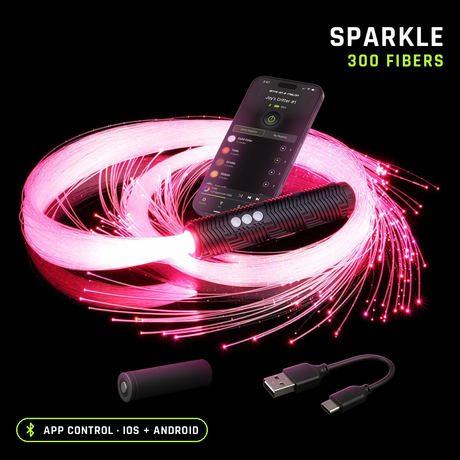
The short answer: yes. An LED whip, saber, staff or fiber optic costume is not a restricted item, and we have never heard of one being confiscated. The part that catches people out is the battery: spare lithium cells are carry-on only and are never allowed in a checked bag, and that includes the 18650 inside your light. We design the BitWhip and the RGB Critter BT in Oregon and fly with them constantly. Here is what the rules actually say, and how we pack.
The short version
Spare 18650 batteries
Cabin bag, every time
Loose cells and power banks are forbidden in checked baggage, and the terminals have to be protected from short circuit.
Carry-on
The light, cell installed
Either bag, powered off
A device with its battery in it can be checked only if it is completely off and cannot switch on in transit. We still carry ours on.
Either bag
The whip, costume or tubes
Either bag, size decides
No electronics in the fiber or the acrylic. The only real constraint is whether it fits your carry-on allowance.
Either bag
The rule people get wrong: spare cells never fly in the hold
Every story we hear that ends badly at a bag drop starts the same way: the spare batteries were in the checked suitcase. The FAA's PackSafe lithium battery page states that "spare (uninstalled) lithium ion and lithium metal batteries, including power banks and cell phone battery charging cases, must be carried in carry-on baggage only," and the TSA lists the same batteries as a flat No for checked bags.
The reason is thermal runaway. A cell that is damaged, crushed or short circuited can overheat without warning, and a fire in the cabin is one a trained crew can reach. A fire in the cargo hold is not.
One consequence catches flow artists in particular: if your carry-on gets gate-checked, the batteries do not go with it. The FAA requires that spare batteries and power banks be pulled out and kept with you in the cabin. Full overhead bins on a festival route is exactly when that happens, so keep your spares somewhere you can reach in five seconds, not buried under a coiled whip.
Protecting the terminals: four accepted methods
Carrying spares on is only half of it. The FAA also requires that battery terminals be protected so they cannot touch other metal, and it lists what counts:
- Leave the cells in their retail packaging. Simplest option, and the one screeners recognize instantly.
- Tape over the terminals. A strip of electrical tape across each end is enough.
- Use a battery case or sleeve. The rigid plastic cases sold for 18650s exist for exactly this.
- Bag them individually. Snugly, in a plastic bag or protective pouch, one cell per bag.
What is not on that list is a loose cell rolling around a pocket with your keys, which is how most spare 18650s actually travel and the one way that is genuinely a hazard. It takes ten seconds to fix.
Watt-hours: the number an 18650 never gets near
The limit you see quoted everywhere is 100 watt-hours per rechargeable lithium ion battery. Between 101 and 160 Wh you need airline approval and are capped at two spares. Above 160 Wh is forbidden outright.
Here is the arithmetic for the cell in an RGB Critter BT. The FAA's own method is to divide milliamp-hours by 1,000 and multiply by the voltage. Our 2500mAh 18650 is 2.5 Ah times roughly 3.7 V nominal, or about 9 watt-hours: one eleventh of the limit, and typical of every 18650 in every flow prop on the market. Under 100 Wh there is no quantity cap either, as long as the batteries are for your own use. Carrying them for resale is prohibited, so a shop owner flying with stock is a different conversation.
Note the caveat the FAA attaches to all of it: many airlines set stricter limits of their own, "regardless of Wh capacity."
The prop itself: what happens at the checkpoint
The TSA allows flashlights in both carry-on and checked bags, and there is no entry at all for whips, fiber bundles or LED props, because they are not restricted items. In our experience the prop is never the problem. A bag check sometimes is: a tightly coiled fiber bundle on a metal-bodied light is a dense, unfamiliar shape on an X-ray, and an officer who cannot resolve it will open the bag. That costs two minutes and nothing else.
You can make it less likely. TSA's own advice on camp stoves applies just as well here: wrap cords and layer items so officers get a clear view. Coil the whip loosely in one layer instead of a fist-sized knot, keep the light and the cells in their own pouch, and be ready to say what it is.
Long rigid props: sabers and staffs
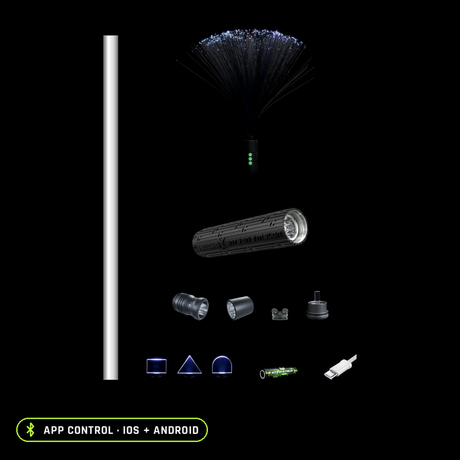
A coiled whip or a fiber costume packs flat. A 24 inch saber tube will not, and an LED staff at 47 to 83 inches is a checked item on any airline. Take the tubes apart: they unscrew from the light, so the electronics ride in the cabin and the empty tubes ride in the hold, which is what the battery rules want anyway. Worth knowing too, the TSA lists martial arts weapons as checked-bag only. An LED staff is not one, but a long rigid tube can read like one on a screen, and every TSA page ends the same way: the final decision rests with the officer at the checkpoint. Checking the tubes removes the argument.
How we pack: the actual bag
- Lights, cells and cable in a hard case, in the cabin bag. The RGB Critter Travel Case ($19.95) holds a Critter, a spare 18650, a charging cable and the small parts that otherwise vanish into a backpack. It settles the terminal-protection requirement too, since the spare sits in its own compartment instead of against your keys.
- Whips in a case, not loose. The BitWhip Travel Case ($29.95) is a hard shell for up to two BitWhips and two Critters plus batteries and a cable. A crushed fiber bundle is the most common travel damage on our repair bench, and it is almost always a whip that went into a duffel bare.
- Spare cells, terminals covered. Two spares covers a full night at roughly 7 hours of runtime each. Spares are $9.95.
- Tubes and hardware in the checked bag. Empty tubes, adapters and end caps have no batteries in them and nothing to declare.
- Charge before you fly. A fully charged cell is fine to carry, and you do not want to be depending on a power bank you may not be allowed to use.
International and festival travel
The 100 Wh and 160 Wh thresholds come from the same international framework, so the numbers travel with you. The handling rules around them have been getting stricter, not looser: through 2025 and 2026 a run of carriers, several in Asia and the Middle East plus the Lufthansa group, tightened rules on power banks, variously banning in-flight charging, requiring them to stay visible rather than go in an overhead bin, or capping how many you can carry. Those rules target power banks rather than bare cells, but the direction is clear, and your airline's dangerous goods page is worth reading before a long routing.
Two practical notes. You probably cannot have batteries shipped to you internationally. We cannot ship standalone cells to international addresses at all, and most reputable sellers are in the same position, so fly with what you need. And if you are heading to a burn, order early and test at home. Burning Man 2026 runs August 30 to September 7, and our Burning Man light costume guide covers dust, cold-weather battery drain and what survives a week on the playa.
Still flying fire props? Same principle as camp stoves: the fuel residue is the problem, not the tool. TSA allows a camp stove only when it is empty of fuel and cleaned so no vapors or residue remain, and used wicks are the opposite of that. It is one of the more boring reasons performers switch, and we covered the rest in fire poi to LED.
Gear you'll want
Light, spare cell and cable, protected in the cabin bag
$19.95; fits any RGB Critter, a spare 18650, a charging cable and small adapters.
Flying with one or two whips
$29.95; hard shell, up to 2 BitWhips and 2 Critters plus batteries and a cable.
Spares so a dead cell does not end your night
$9.95 each, about 9 Wh. Cannot be shipped to international addresses.
One prop that packs flat and travels well
From $159.95; coils into a carry-on, and the light twists off to power everything else you own.
Flying with LED props FAQ
Can I put my LED whip in a checked bag?
The whip itself, yes. Take the light out and carry that with you, and never put a spare battery in a checked bag. A device with its cell installed may be checked only if it is completely powered off and cannot switch on by accident.
Are 18650 batteries allowed on planes?
Yes, in carry-on baggage, with the terminals protected from short circuit. A 2500mAh 18650 is about 9 watt-hours, far below the FAA's 100 Wh per-battery limit.
How many spare batteries can I bring?
Under 100 Wh the FAA sets no quantity limit, provided the batteries are for your own use and not for resale. Airlines can set stricter limits, so check yours if you are carrying more than a couple.
Will TSA search my bag because of the whip?
Sometimes, and it is not a problem. A coiled fiber bundle on a metal-bodied light is an unfamiliar X-ray shape. Pack it in one loose layer with the light and cells in their own pouch, and expect a two-minute check.
What about an LED staff or a long saber tube?
Check the tubes and carry the lights. A 47 to 83 inch staff meets no carry-on size limit, and the TSA lists martial arts weapons as checked-bag only, which a long rigid tube can resemble on a screen. Separating them satisfies the battery rules and the size limits at once.
Do the rules change on international flights?
The 100 Wh and 160 Wh thresholds are the same, but several international carriers have tightened power bank handling since 2025. Read your airline's dangerous goods page, and note that standalone batteries usually cannot be shipped to an international address, so bring what you need.