Saber Tubes, Blades and Caps Explained: Which Diffuser Fits Your RGB Critter?
 7 min read
The question every RGB Critter owner asks before the second purchase: which diffuser? Everything we make twists onto the same light, the RGB Critter BT, but the attachments split into three families that shape light in three different ways: rigid tubes, flat blades, and the caps and adapters that join everything together. Here is the full taxonomy, what each family actually does to the light, and which one to buy first for the way you play.
The short version
Bold geometry and sabers
Light painting tubes
Rigid diffusers in a plain finish plus Honeycomb, Spiral Dots and Dots Combo patterns, six lengths each. The same tube system builds sabers and staffs.
$24.95-$54.95
Crisp edges and planes
Light painting blades
Flat clear acrylic blades that turn the beam into ribbons and slashes in camera. They mount in the $19.95 Light Painting Blade Holder.
From $4.95
The connective tissue
Caps and adapters
End hardware and adapters: the T8 Modular Adapter, and the Critter Connector that joins two Critters back to back for staffs and doubles.
$19.95-$24.95
The 60-second taxonomy
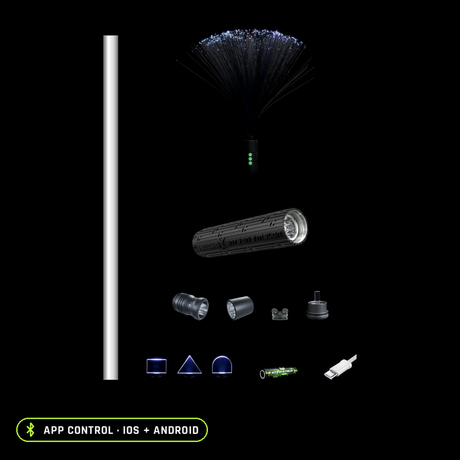
Three families, one rule. Tubes are rigid diffusers that glow along their whole length: the saber and staff look, and bold geometry in light painting. Blades are flat acrylic planes that shape the beam into crisp edges: the photography workhorse. Caps and adapters are the connective tissue: the hardware that mounts a Critter into a tube, joins two Critters back to back, or finishes the end of a build. And the rule that makes the whole system work: every one of them attaches to the same RGB Critter BT, part of an ecosystem of over 200 accessories, so nothing you buy today gets orphaned by what you buy next.
Tubes: bold geometry, sabers and backdrops
The modular light painting tubes are diffusing shapes for bold geometric strokes and wall-of-color backdrops, and because they are modular, the same tubes assemble into sabers, which is where the photography side of the platform crosses over into the flow side. Four tube patterns, each in six lengths from 5 to 36 inch, running $24.95 to $54.95 by length:
- Light Painting Tube: the plain one. A smooth, even wall of color, the cleanest trails in camera, and the cheapest of the four at some middle lengths ($39.95 at 23 inch, where the patterned tubes are $44.95).
- Honeycomb: laser-cut hexagons that break the glow into crisp, geometric patterns.
- Spiral Dots: a laser-cut dot pattern that draws dotted, swirling trails.
- Dots Combo: dual laser-cut dot patterns on one tube.
The same smooth-versus-textured logic applies here as on our saber blades: a plain diffuser reads cleanest in motion and in long-exposure photos, and a patterned one adds texture to every spin at the cost of a busier trail. For the deeper pattern comparison, our LED saber guide walks the Sol, Honeycomb, Butterfly and Stellar blade patterns one by one.
Blades: crisp edges and planes in camera
Our light painting blades are clear 8mm acrylic blades that catch and shape the Critter's light into crisp edges and planes. Sweep one through a long exposure and you get a solid ribbon of color; flick it and you get sharp slashes. Blades start at $4.95 each, which makes them the fastest and cheapest way to make a single Critter look like a full lighting rig in camera.
The one thing to know before ordering: blades mount in the Light Painting Blade Holder ($19.95), which attaches them to the Critter. Buy the holder once, then collect blades at a few dollars each for as many shapes as your shots need.
Caps and adapters: the connective tissue
The third family is hardware, and it decides what your builds can become:
- T8 Modular Adapter ($19.95, in standard and XL sizes): mounts a Critter into T8 tubes.
- Critter Connector ($24.95): joins two Critters back to back for double-ended whips, staffs and contact tools.
- Saber blades as accessories: every saber blade pattern is a twist-on accessory in the saber accessories collection, $15 to $55 depending on pattern and length, so a Critter owner never has to buy a whole saber kit to get the saber look.
- End caps and hilt hardware: the caps and counterweights that finish a build round out the same saber accessories collection.
Which to buy first, by use case
Light painting photography first: start with blades. A blade at $4.95 plus the $19.95 holder is under $25 all in, and it is the fastest route to a shot that looks lit by a whole rig. Add one plain Light Painting Tube ($24.95 at 5 inch) when you want backdrops and bold geometry behind a subject.
Flow and performance first: go tube. If you do not own a Critter yet, the premade Saber Kit (from $209.95) is the complete package: light plus blade in one box. If you already own one, a tube or a twist-on saber blade gets you spinning for a fraction of that.
Double-ended ambitions: a second Critter and the $24.95 Critter Connector turn two lights into one staff or double-sided build, and the app keeps the lights in sync.
Not sure which camp you are in? Our kit chooser sorts it out in one question, and the light painting techniques guide shows what each shaper does in a real shot.
The compatibility rule
The reason this taxonomy stays simple: the modular mount is consistent across the ecosystem, so one Critter powers any compatible tool, and the only question is which attachment is on the front. Double-ended tools are the one exception, using two Critters joined by a connector. The app controls up to 10 connected lights together, so multi-Critter builds stay in perfect color sync while you perform or shoot. If you have an older piece and are not sure it fits, contact support with the part and we will confirm fit before you order.
Gear you'll want
One tube to start: smooth, even trails
$24.95 to $54.95 by length; the plain pattern, cleanest in camera.
The blade mount you only buy once
$19.95; the blades themselves start at $4.95 each.
Two Critters, one double-ended build
$24.95; joins two lights back to back for staffs and double whips.
Tubes, blades and caps FAQ
Do all tubes fit the RGB Critter BT?
Yes. The modular mount is consistent across the ecosystem, so any current tube, blade holder or adapter attaches to the same light. If you have an older piece and are not sure, contact support with the part and we will confirm fit.
What is the difference between a tube and a blade?
A tube is a rigid cylinder that glows along its whole length, so it reads the same from every angle: the saber and staff look. A blade is a flat acrylic plane that shapes the beam into crisp edges and ribbons in camera. Tubes cross over into performance; blades are photography-first.
Which tube pattern should I start with?
The plain Light Painting Tube. Its smooth, even glow is the cleanest look in motion and in long exposures, and it is the cheapest of the four at some middle lengths. Add Honeycomb, Spiral Dots or Dots Combo when you want texture in the trail.
Do I need the Blade Holder to use blades?
Yes. Blades mount in the $19.95 Light Painting Blade Holder, which attaches them to the Critter. One holder covers a whole collection of blades, which start at $4.95 each.
Can I join two Critters together?
Yes. The $24.95 Critter Connector joins two Critters back to back for double-ended whips, staffs and contact tools, and the app can control up to 10 connected lights in sync.
Are saber blades and light painting tubes the same thing?
Same family. The modular tubes assemble into sabers, and the saber kits build from the same tube system, so parts carry over between the photography and flow sides. Saber blades are also sold alone as twist-on accessories, $15 to $55 by pattern and length.